Study Reframes Brain Evolution Beyond the “Lizard Brain” Model
Research published in Science Advances suggests mammalian brain evolution may reflect a trade-off between two competing wiring strategies rather than a progression from an ancient “lizard brain” to newer rational regions. Analysis spanning 182 species and experiments with artificial neural networks linked the balance to animals’ sensory demands, including smell and vision.
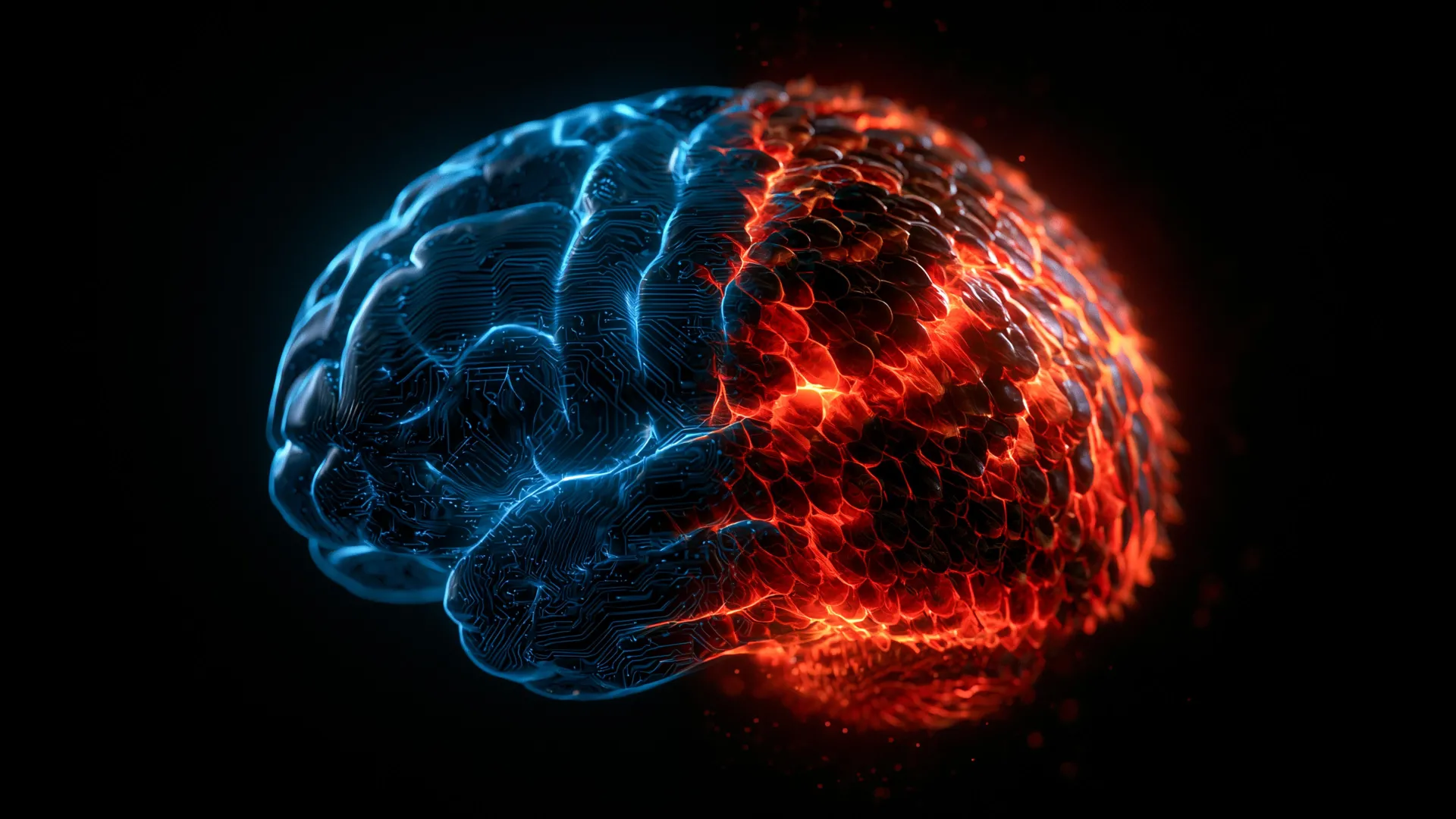
A study published in Science Advances challenges the familiar idea that the human brain evolved by stacking increasingly sophisticated regions on top of an ancient “lizard brain.” The researchers instead describe brain evolution as a resource-allocation problem involving two different forms of neural organization.
The work was led by Nabil Imam of Georgia Tech, in collaboration with Cornell University. The team examined how the neocortex and limbic system vary across mammalian species, rather than treating individual brain regions as independent structures. Across 182 species, larger limbic-system regions generally appeared alongside one another, while the neocortex tended to be relatively smaller. The researchers interpreted this as coordinated expansion and contraction between broader neural systems.
The popular “lizard brain” framework, proposed in the 1950s, portrays brain evolution as a series of layers: basic bodily functions first, followed by emotion and then advanced reasoning. The researchers argue that this picture oversimplifies the structures grouped under the term. The limbic system, often associated broadly with emotion, includes regions involved in memory, smell, navigation and emotional regulation, while the neocortex contributes to vision, perception, reasoning and other complex functions.
The study focuses on how these systems are wired. Neocortical circuits are organized into spatial maps, placing processing areas for nearby body parts or related sensory inputs near one another. Limbic circuits, by contrast, use distributed activity patterns that the researchers compare to bar codes, with representations for smells or complex memories spread across networks.
Artificial neural-network experiments were used to test the functional consequences of these arrangements. Networks with localized connections performed well on vision, sound and touch tasks. Distributed wiring was needed for strong performance in smell recognition and memory tasks.
The researchers then built a multimodal artificial network in which the two wiring strategies competed for limited space. When the simulated environment rewarded smell, the distributed system expanded while the neocortex became smaller. When vision was favored, the relative pattern reversed. The source compares this model with differences between animals such as the smell-dependent nine-banded armadillo, which has a large limbic system, and the vision-oriented squirrel monkey, whose brain is more dominated by the neocortex.
These findings do not establish that the model fully explains brain evolution, nor do they show that the artificial networks reproduce biological brains. The AI results were simulations testing how wiring architectures perform under different demands. The researchers say the work could eventually inform AI systems designed with more built-in structure, potentially reducing dependence on large amounts of training data and energy. The study was supported by the National Science Foundation.
Reporting Note
Biohack Report distinguishes preliminary findings, clinical evidence and commercial claims whenever the available reporting supports that distinction. Coverage is informational and is not medical advice.